Jamaica Magnified
A deep-dive into the abuse of the Rio Cobre by multi-million dollar bauxite mining company WINDALCO.
Introduction
This investigative story focuses on the repeated issue of the pollution of the Rio Cobre. The West Indies Alumina Company (WINDALCO) has been a repeat offender of the National Resources Conservation Act and the Wildlife Protection Act. The National Environment Planning Agency (NEPA) has identified the St. Catherine mining plant of WINDALCO as the source of an influx of toxic waste, or trade effluent, into the river, causing at least four fish kills in the last decade. After every incident, residents often call for the cessation of WINDALCO’s operations and harsher fines. In July 2022, NEPA indicated as part of its penalty against WINDALCO, a total drawdown of the Environment Performance Bond of over US$700,000 (more than $117 million Jamaican dollars). In a release issued by the Jamaica Environment Trust, a non-governmental environment advocacy organization, Chief Executive Officer Dr. Theresa Rodriguez-Moodie wrote “It is also our understanding that the amount needed to compensate those affected by this most recent incident is not adequately covered by the Environment Performance Bond, therefore who will have to pay? Will it be taxpayers who have to pay for the actions of WINDALCO?”
For years, WINDALCO has been instructed to construct a new pond or increase the capacity of its current effluent pond. This story seeks to share the stories of those closest to the river, who are affected by its pollution. Will WINDALCO be allowed to operate before its effluent disposal is completed in the same way as previous years? This investigative story uncovers the impact this multi-million-dollar company has on the environment, and the livelihoods of some of the most vulnerable citizens of Jamaica.

The bauxite industry in St. Catherine
In January 2022, West Indies Alumina Company (WINDALCO) cut the ribbon to announce its construction of a second effluent holding pond (EHP), which would safely manage the disposal of all toxic waste from its St. Catherine mining plant. Labelled as the entity liable for another fish kill just months later in July, subsequent media reports stated that WINDALCO had “taken steps to fast track the completion” of this second pond. It was initially set to be completed by the end of 2022.
DIGITIMES investigations have revealed that construction of the pond has been paused and is now set to resume sometime in 2023. Its location is less than 250 meters from Charlemont High School.
Second EHP
Second EHP
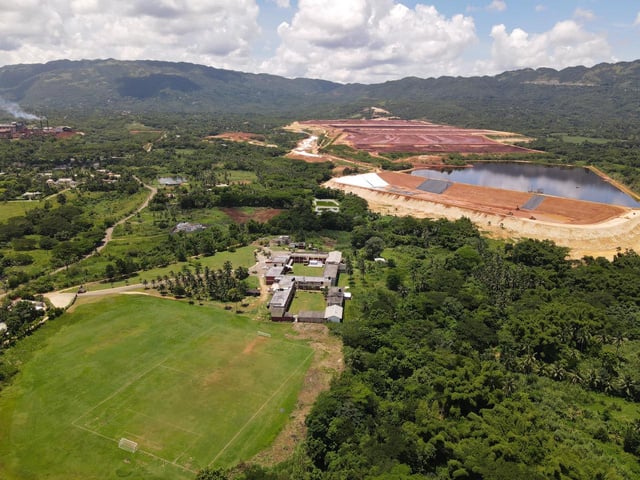
Charlemont High School
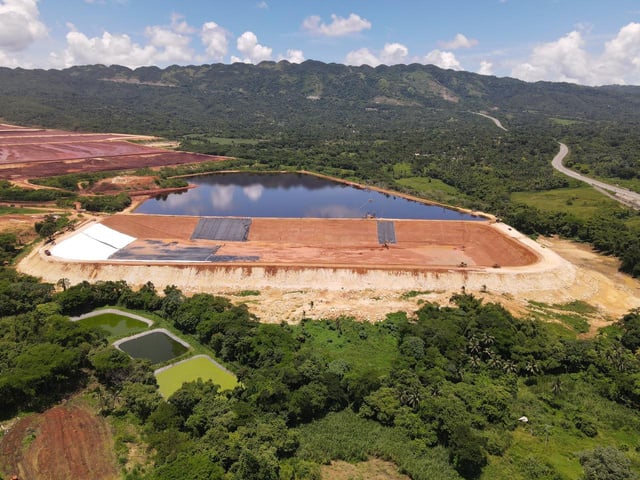
Credit: Jamaica Environment Trust
The toxic waste that would be disposed of in this effluent holding pond is primarily made up of caustic soda, otherwise known as sodium hydroxide. The placement of the pond is concerning because caustic soda can have serious health effects when inhaled, ingested or when it comes into contact with the skin. Studies by the World Health Organization have explained that inhalation can aggravate conditions such as asthma and sinusitis, and repeated inhalation of sodium hydroxide vapor can lead to permanent lung damage. Prolonged or repeated skin contact may cause dermatitis.
Dr. Norbert Campbell, Lecturer/Coordinator of the Occupational and Environmental Safety and Health (OESH) programme at the University of the West Indies says that depending on the concentration of sodium hydroxide, it can be an irritant to the skin, mucus membranes and respiratory tract of humans. He says young children are especially vulnerable because their developmental processes could be more affected than an adult's.
Dr. Norbert Campbell, Lecturer/Coordinator of the Occupational and Environmental Safety and Health (OESH) programme at the University of the West Indies.
According to Anthony Mackenzie, Deputy Director of Environmental Management and Conservation at the National Environment and Planning Agency (NEPA), an environmental impact assessment was not done before this pond was constructed, nor was one required. However, the Natural Resources Conservation Authority Act (NRCAA) states that any construction being undertaken that may affect the environment should be submitted along with such an assessment.
The school was not consulted on the possible effects the pond’s proximity will have on its population. Initial discussions with Garth Gayle, principal of Charlemont High School, revealed there are concerns for members of the school population. However, he is hesitant to share his perspective in greater detail, given his position as head of the government-run institution.
Garth Gayle, Principal of Charlemont High School.
This is not the first time WINDALCO has been in the media for controversy surrounding its operations. Owned by UC Rusal, an international conglomerate owned by Russian stakeholders, not much is known about the country’s operations in Jamaica. The company has been responsible for four fish kills in the last decade.
Since 2010, WINDALCO has received at least 15 warning, enforcement, and breach notices for failure to comply with environmental permit conditions. In 2019 and 2021, it was brought before the court for the breaches committed in these years. The proceedings are still ongoing. In an article published October 16, 2022, written by Dr. Theresa Rodriguez-Moodie, residents have reported the pollution of the Rio Cobre to be a long-standing issue since the 1980s, with some expressing that the effluent is purposely released into the Rio Cobre river.
The Rio Cobre is a major river that meets the domestic, recreational and agricultural needs of its environs. There are over 100 informal fishermen who use the ecology from the river as their means of living. They consume their catch themselves for their own survival, as well as sell to any interested passers-by and restaurants. Additionally, the National Water Commission (NWC) operates along the river, supplying water to approximately 150,000 Jamaicans in the St. Catherine as well as the Kingston and St. Andrew areas. The National Irrigation Commission (NIC) provides water for agricultural purposes for over 200 farmers from this river.
The National Environment Planning Agency (NEPA), an agency under the Ministry of Economic Growth and Job Creation, is chiefly responsible for environmental protection, natural resource management, land use and spatial planning in Jamaica. Under those responsibilities, some of its duties include enforcing the Natural Resources Conservation Authority Act (NRCAA) and the Wildlife Protection Act (WPA). Both legislations are tasked with protecting the natural resources of Jamaica, an island in which its population is heavily dependent.
The legislation reads that NEPA has the right to suspend or revoke the environmental permits and/or licences of any applicant under the NRCAA and the WPA. They are also liable to fines of 50 thousand dollars JMD under the NRCAA and 100 thousand dollars JMD under the WPA upon conviction of the court.
An environment performance bond (EPB) was introduced after countless calls for stricter and increased penalties from members of the public and various advocacy organisations. The EPB requires WINDALCO to set aside a sum of over US 700 thousand dollars, equivalent to approximately $117 million JMD, before the start of its operations. It is required to secure the amount with a bank, and in the event of any adverse environmental impact during operation, it will be used for mitigation and restoration efforts. It should act as a harsher penalty to WINDALCO.
The fines of the NRCAA, WPA and the EPB should act as a deterrent to companies from polluting the environment. But WINDALCO, according to an annual report from 2017 that was retrieved by the DIGITIMES team, earns over nine million US dollars in net profits annually. Comments in the public domain are that these fines are a simple slap on the wrist in comparison to WINDALCO’s profitable enterprise.
On November 9, 2022, the Ministry of Economic Growth and Job Creation released a statement detailing the breakdown of the bond’s use for restorative work. It noted that the damage done to the river and stakeholders affected had far exceeded the value of the bond – being estimated at over $200 million. According to the release, fisherfolk will receive $16 million in compensation. Minister of Economic Growth and Job Creation, Matthew Samuda explained in the statement that the shortfall “will be addressed through other legal channels to hold WINDALCO accountable, and with upcoming budgetary allocations.” At the date of publishing, this shortfall remains to be addressed by the Minister.
Kestonard Gordon, Vice Chairman of the St. Catherine Parish Development Committee, saw the residents protesting the fish kill when it first occurred in July 2022, and took on the responsibility of organising and filing the compensation claims for the fisherfolk. This was particularly difficult, as the fisherfolk were never required to be registered or have certain documents to be formalised into a system. He says the value of the claims he received was over $100 million, so the $16 million from the government is not enough.
Kestonard Gordon, Vice Chairman of the St. Catherine Parish Development Committee.
One such fisherman who anxiously awaited some sort of support from the government is Wayne Williams. He has been fishing at the Rio Cobre since the 1980s. He loves fishing for fun, but it is also how he feeds himself and his family of seven. He also sells his catch to surrounding restaurants in the St. Catherine area, as well as restaurants as far as to New Kingston. He says he has been told that the Prime Minister and other government officials have eaten his catch. So, the reach of these fisherfolk is islandwide, as well as the risk of consuming contaminated fish.
In January 2023, six months after the pollution incident, some fisherfolk, including Williams, received the compensation cheques promised by the Government. Williams says he is grateful for the Government’s consideration in compensating the fisherfolk, but it is not an end to the problem. He would like to see the river replenished with the marine life that was lost, and for WINDALCO to stop polluting the river completely.
Wayne Williams, fisherman of the Rio Cobre.
The Government calculated the losses for fisherfolk through an average daily catch for 10 days. But at the time of interview, seven months after the effluent spill, fishers are still unable to see their normal daily catch and must venture to other areas to fish or seek other means of employment to supplement their daily expenses.
In addition to the effect on livelihoods, there are concerns for food security and on public health. Dr Theresa Rodriguez-Moodie, Environmental Scientist and Chief Executive Officer of the Jamaica Environment Trust, is concerned about the possibility of bioaccumulation. She explains bioaccumulation as the possibility of metals – like the aluminium mined by WINDALCO - accumulating in the organisms that live in the water. This is then consumed by other larger organisms, and possibly accumulate in their body at dangerous levels. But studies on this phenomenon, and the general long-term implications of the repeated pollution of the river have not been done.
Dr. Theresa Rodriguez-Moodie, Environmental Scientist and Chief Executive Officer of the Jamaica Environment Trust.
According to DIGITIMES investigations, residents from surrounding communities were contracted to clean the river of the dead fish. Community leader and resident of Bog Walk of 40 years, Billy Paul, explained that Kestonard Gordon encouraged the residents to reject the contract from WINDALCO and allow them to clean the river themselves. But Paul says the residents suffer the stench the most and are eager to have it cleaned, so they take the responsibility upon themselves. Additionally, some of the residents need the money. But in the 2019 incident, the residents were never paid for their efforts.
Billy Paul, Community Leader and Resident of Bog Walk.
However, Paul says the most recent clean-up efforts in 2022, ran more smoothly. The workers were paid, albeit not what they bargained. But the residents were willing to take whatever they could to help provide for themselves.
During the clean-up process, the residents were not provided with protective equipment for their bodies from the caustic soda, and they must submerge themselves fully into the water. The residents built catchments with nets and bamboo sticks to retrieve the dead fish and other aquatic species. They also had to build bamboo rafts to go out into the river. Some had to seek medical attention for illnesses or skin burns from the process. Residents were reportedly paid five thousand dollars a day to clean the river.
Diane Thompson is a 42-year-old mother of two. She owns a shop and operates a restaurant, where she normally sells the cray fish her brothers catch from the Rio Cobre. Her means of making a living is put on pause each time the river is contaminated.
She told the DIGITIMES team that she had to go to the doctor for prescription medication, after she sustained severe rashes, and her sinuses were aggravated while cleaning the river.
Diane Thompson, resident of Kent Village.
In January 2022, Minister of Transport and Mining, Hon. Robert Montague said the construction of the second EHP would be an end-all to the pollution of the Rio Cobre by WINDALCO. Dr. Rodriguez-Moodie expressed her doubts that the construction of a second effluent holding pond is the most efficient way of dealing with this recurring issue. Numerous requests from JET to both NEPA and WINDALCO have gone unanswered, as to whether best available technology and practices have been considered, as there are other international models and existing practices in the European Union, that mining companies like WINDALCO are mandated to follow. She questions why those practices are not followed in Jamaica.
Dr. Theresa Rodriguez-Moodie, Environmental Scientist and Chief Executive Officer of the Jamaica Environment Trust.
At the time of this report, WINDALCO continues its operations at the St. Catherine Plant. The last notice of intention to suspend their licence under the NRCAA Act and the WLP Act was served in July 2022. Their effluent holding pond is incomplete and court matters are ongoing.

*Click to play audio
*Click to play audio
*Click to play audio
*Click to play audio
*Click to play audio
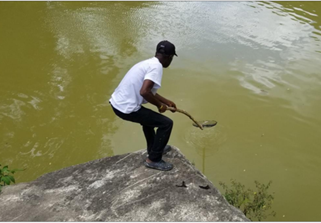
Clean up efforts of the Rio Cobre. Credit: NEPA
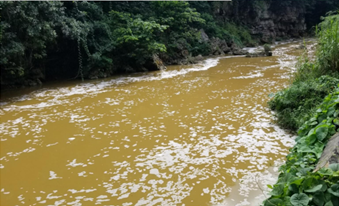
Rio Cobre polluted with caustic effluent. Credit: NEPA
Ashanna Jackson | DIGITIMES
Jamaica Magnified
Gallery
Rio Cobre polluted with caustic effluent. Credit: NEPA
Clean up efforts of the Rio Cobre. Credit: NEPA
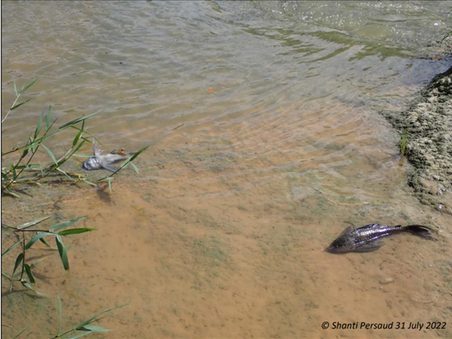
Dead fish in the Rio Cobre. Credit: NEPA
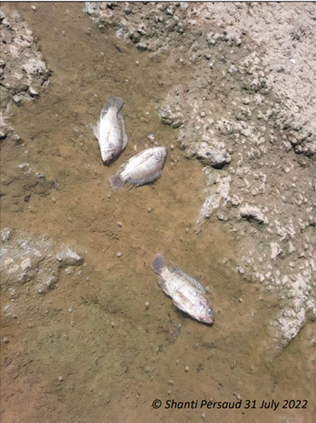
Dead fish in the Rio Cobre. Credit: NEPA